![taxtraders-black-1.png]](https://knowledge.taxtraders.co.nz/hs-fs/hubfs/taxtraders-black-1.png?height=28&name=taxtraders-black-1.png)
When adding an associated taxpayer, you must now specify whether the associate is part of the same group of companies. This selection determines whether funds stay as own funds or become purchased funds, ensuring the Tax Traders portal applies the correct tax pooling rules.
Overview
We’ve updated the Tax Traders portal to ensure associated taxpayer relationships are correctly captured when funds are transferred between related entities.
When you add an associated taxpayer, you will now be asked to confirm whether the associate is part of the same group of companies as the taxpayer who holds the deposited funds.
This selection determines how funds are treated when moved between entities – specifically, whether they are transferred as own funds or purchased funds, based on legislative rules in the Income Tax Act 2007.
What’s new?
When adding an associate, you’ll now see a new field as follows:
'Common ownership?' – Yes / No
This indicates whether the associated entity meets the common ownership criteria for being treated as part of the same group under the Income Tax Act 2007. This specifies that for entities to be part of the same group of companies, they need to have at least 66% common ownership interests.
Selecting the correct option ensures the portal automatically applies the correct legislative treatment when transferring funds.
Please note that other entity types other than company are automatically deemed by IR to not have common ownership based on the legislation (e.g. individuals, trusts).
Where this appears in the portal
When adding associated taxpayers, you’ll now see a screen like this:
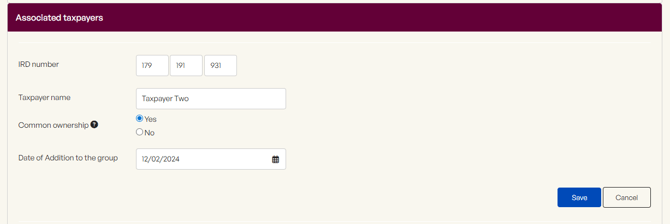
The new field appears whenever you add or edit an associated taxpayer.
Once saved, these details will automatically populate when creating transactions and advise us how these funds should be applied when they are sent to Inland Revenue (IR).
Why this matters: How group status affects fund transfers
The tax treatment depends on whether:
- the entities were in the same group at the time the deposit was made, and
- they share at least 66% common ownership.
Below is a simple explanation of how the rules apply.
1. Transfers between companies that WERE in the same group at the time of deposit (≥66% common ownership)
If the associated entity:
- was part of the group when the deposit was made, and
- shares at least 66% common ownership,
then the deposited funds remain own funds, and:
What transfers are allowed
✔ Transfers of deposit funds can be made to the associate’s IR account at any time, as long as filing requirements for that year are complete.
✔ Transfers can be made at date of deposit for income tax and non‑income tax types.
2. Transfers between entities that do NOT satisfy the group criteria (<66% ownership OR not in the group at deposit time)
If the associated entity does not meet common ownership rules or wasn’t part of the group when the funds were deposited, then the funds become purchased funds when transferred.
What transfers are allowed
✔ Income tax only – transfers can be made only for an open income tax year.
✔ Timing requirement – transfers must be completed within 75 days of the associated entity’s terminal tax date for that year.
✔ Non‑income tax types – transfers are only allowed if:
- the tax type has been reassessed; and
- the transfer occurs within 60 days of the reassessment notice.
Example: How the rules apply in practice
Here is a simple example showing how fund treatment varies based on ownership:
Taxpayer One owns:
- Taxpayer Two - 100% ownership
- Taxpayer Three - 10% ownership
- Is associated with Shareholder One
- Is associated with Shareholder Two
Resulting fund treatment
| Transfer To | Ownership / Group Status | Fund Treatment |
|---|---|---|
| Taxpayer One | Same entity | Own funds |
| Taxpayer Two | 100% owned (in group) | Own funds |
| Taxpayer Three | 10% owned (<66%) | Purchased funds |
| Shareholder One | Not part of group | Purchased funds |
| Shareholder Two | Not part of group | Purchased funds |
This is why selecting the correct 'Common Ownership?' status is important as the portal uses this information to automate these legislative outcomes.
Please note that as a conservative approach, when common ownership has not been specified, the system will ensure this does not apply and the funds will be treated accordingly.
If you need help: